
Care instructions
In collaboration with our manufacturers and leading detergent producers, we have compiled unique care instructions for our customers to ensure optimal care for our high-quality products.General
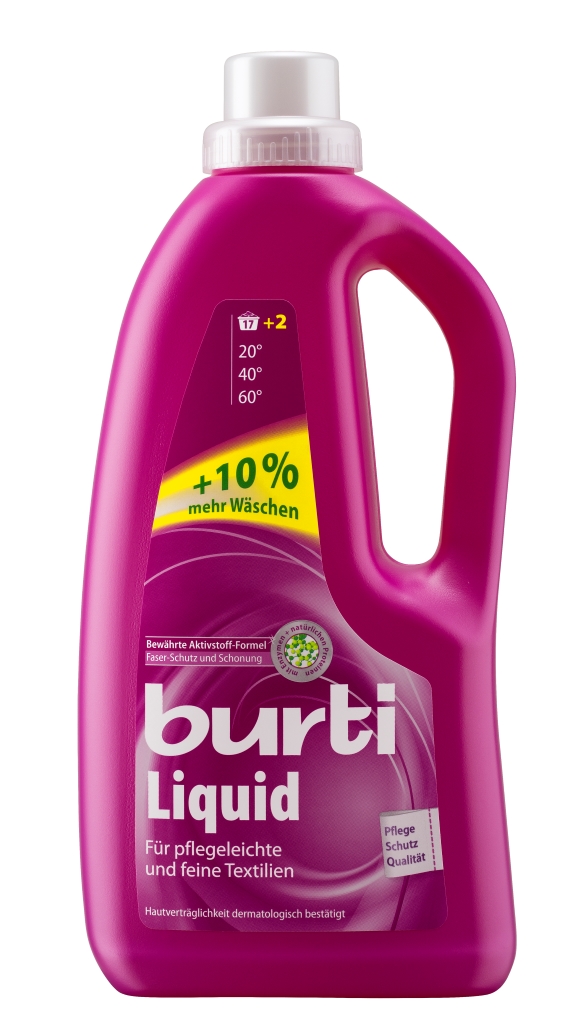
WashingPlease use exclusively liquid detergent for caring for your laundry — one that is free from optical brighteners and free from bleaching agents. Using powder detergents carries the risk of detergent residue remaining in the washing machine. If you use a powder containing bleach, for example, these residues may cause spotty bleaching on coloured bed linen in the next wash cycle. Liquid detergent, added directly to the drum, does not leave such residues. Following consultation with our manufacturers, we recommend the liquid detergent burti Liquid, which is available from any well-stocked drugstore or supermarket:
Bed linen
WashingAlways follow the care instructions on the sewn-in labels. For hygiene reasons, new bed linen must always be washed before first use.
Duvet covers and pillowcases should be turned inside out for washing, and all fastenings should be closed. Do not overload the drum — bed linen should sit loosely inside it. Make sure the washing machine is in good working order and free from mechanical damage. Never wash bed linen together with jeans, terry items or coarse fabrics, as friction can damage the fabric.
For bed linen, use a liquid colour detergent or a liquid delicate detergent free from bleaching agents and optical brighteners. Always wash white and coloured bed linen separately and at 60°C. This also applies to silk bed linen. Do not use fabric softener — fabric softener can permanently damage high-quality fibres and leaves a soapy film on the bed linen. You should also avoid chlorine bleach and stain removers, as these can discolour bed linen and cause uneven colouration.
Bed linen should not be spun at too high a speed, as the resulting creases are difficult to remove. If the bed linen is hung up while still slightly damp, very few creases will remain.
Drying
Damp bed linen should be removed from the washing machine promptly.
Bed linen that is not to be tumble dried should be pulled into shape while damp and laid over several washing lines to dry. This gives you virtually crease-free bed linen that, depending on personal preference, may not need ironing at all.
If you prefer to use a tumble dryer, please make sure not to over-dry the bed linen. Always select the delicate programme for drying.
Ironing
Please refer to the sewn-in label in your bed linen for the correct iron temperature setting. Bed linen is easiest to iron when still slightly damp. Jersey bed linen does not need to be ironed.
Mangling
In principle, bed linen can also be put through a mangle. Please bear in mind that mangling places a very high mechanical load on the fabric. We recommend speaking with your trusted laundry service in advance about how the bed linen will be mangled — for example, whether button fastenings will be mangled over, and how the bed linen is cleaned.
Terry items
WashingAlways follow the care instructions on the sewn-in labels. For hygiene reasons, new terry items must always be washed before first use. For bathrobes, a so-called pre-shrinkage allowance is always factored in — meaning that the terry fabric will shrink slightly on the first wash at 60°C and will then have reached its correct size. If the unwashed bathrobe fits comfortably over clothing, it will fit perfectly against the skin after the first wash.
Always wash terry items with a well-filled machine. Make sure no garments with hooks or zips are washed together with terry items, as these can cause snagging. If the terry fabric does snag a thread, there is no need to worry — simply cut the thread short. Please do not pull on the thread.
For terry items, use a liquid colour detergent or a liquid delicate detergent free from bleaching agents and optical brighteners. Always wash light and dark terry items separately and always at 60°C. Cooler wash programmes or delicate programmes can cause terry items to bleed or change colour. This will not happen if you wash terry items at 60°C. Do not use fabric softener, as it adheres to the cotton fibres like a film and impairs the absorbency of the terry fabric. Furthermore, fabric softener increases the formation of lint.
Drying
Damp terry items can be dried either on a washing line or in a tumble dryer. When using a tumble dryer, please select the "gentle drying" setting at a temperature of 60°C.
Ironing
Terry items should generally not be ironed. Bathrobes with a satin or damask outer fabric may be ironed on a low setting while slightly damp.
Duvets and pillows
GeneralDuvets and pillows should be shaken out regularly. When airing, please ensure that the duvets are not exposed to direct sunlight. Duvets should be professionally cleaned approximately every 5–8 years. We are happy to arrange this for you. Pillows should be replaced every 3–5 years due to the high level of use they receive.
Washing
Always follow the care instructions on the sewn-in labels, as these will indicate whether your duvets and pillows can be washed and at what temperature. Use a sufficiently large washing machine, as bedding can absorb many times its own weight in water. For a duvet with a 3-warmth rating in size 155×220 cm, the washing machine must have a minimum load capacity of 6 kg; for a lighter or smaller duvet, a minimum capacity of 4 kg is required.
For duvets and pillows, a pH-neutral liquid delicate detergent free from bleaching agents and optical brighteners is recommended. Please select a wash programme that includes a spin cycle, so that the majority of the absorbed water is spun out.
Drying
Where indicated on the sewn-in label, duvets and pillows should always be tumble dried. Please do not add any other laundry to the dryer. For down duvets and pillows, you can set the tumble dryer to "extra dry" or "maximum temperature"; for synthetic products, we recommend a temperature setting of 60°C.
The drying process should be interrupted every 30 minutes to shake the duvets and pillows briefly. They should then be returned to the tumble dryer to continue drying. After approximately 60–120 minutes of drying time, the tumble dryer should be allowed to run on a cool cycle for a few minutes.
Once the duvets and pillows are dry, allow them to cool and then check the residual moisture content by kneading them thoroughly, as warm duvets and pillows generally feel drier than cold ones. If necessary, you can repeat the drying process.
Bedspreads and throws
WashingAlways follow the care instructions on the sewn-in labels, as some throws cannot be washed at all or only under certain conditions. For throws that are washable, use a liquid delicate detergent free from bleaching agents and optical brighteners.
Drying
Please follow the drying instructions on the sewn-in labels.